Duvets keep you at the right temperature while you sleep and must also ventilate well.
Duvets are usually filled with down, wool, or synthetic fibers.
Each material has its own advantages and disadvantages.
Which duvet should I choose?
Many people ask for a warm duvet. Unfortunately, a duvet itself is not warm; it has an insulating function and ensures that your body heat is retained.
Things to consider when buying a new duvet:
Do you sleep in a single or double bed?
If your bed width is 80, 90 or 100 cm,
the best choice is a single duvet: 140 x 200 cm or 140 x 220 cm.
If your bed width is 120 or 140 cm,
the best choice is a double duvet: 200 x 200 cm or 200 x 220 cm.
If your bed width is 160 or 180 cm,
the best choice is a queen-size duvet (lit jumeaux): 240 x 200 cm or 240 x 220 cm.
If your bed width is 200 cm or wider,
the best choice is an extra wide duvet: 260 x 220, 260 x 240 cm, 280 x 220 cm or 280 x 240 cm. – These larger sizes are always custom-made. They are only produced once ordered, which means it may take a little longer before we can ship them.
Which filling suits me best?
Most people are familiar with fillings such as down, wool, feathers, or synthetic, but do you know Tencel or silk?
Down:
Down is the soft, fluffy material found beneath the outer feathers of birds, especially waterfowl such as ducks and geese. It is extremely light and an excellent insulator because it traps air and retains heat. There are different types of down, such as duck down and goose down. Goose down is usually warmer and of higher quality.
Quality:
Down (the smallest, softest feathers) and feathers exist in various qualities. Down is lighter and warmer than feathers. They are often mixed: the more down, the lighter and warmer the duvet. The coarser the feathers, the greater the chance you will feel them through the bedding. Also, the location where the geese are raised matters: the colder the region, the larger and better the down clusters and the higher the fill power.
Compartments:
To prevent the filling from shifting over time, duvets are stitched into compartments. Different methods are used, such as squares (carreaux) or channels. Stitching creates small holes through which down may escape. To counteract this, the thermo-fixation method is sometimes used—a type of heat bonding.
Cover (ticking):
The ticking of the duvet must be tightly woven so that even the smallest feathers cannot escape. High-quality cotton is usually used for this. Cotton easily absorbs moisture and releases it back into the air.
Four seasons:
There are down duvets for the colder and warmer parts of the year, as well as four-season duvets, with two (or more) detachable layers. A specialist store can advise you, but remember: besides quality, your personal preference is very important.
Wool:
Wool is a natural fiber from animals such as sheep, alpacas, goats (cashmere, mohair), and rabbits (angora). It is known for warmth, softness, and breathability. Wool is naturally insulating, moisture-regulating, and self-cleaning, making it ideal for colder climates.
Synthetic fibers:
There are many different synthetic fibers that vary greatly in weight, insulation, breathability, and durability. The downside is that they usually ventilate less well than down or wool. The advantage is that synthetic duvets are much cheaper than wool and down, and they are machine washable.
Tencel:
Tencel is a sustainable, eco-friendly fiber made from wood pulp, usually eucalyptus, beech, or spruce trees. The most common types are Lyocell and Modal. Tencel is very soft and smooth, making it a pleasant material for duvets and duvet covers.
Silk:
Silk is a luxurious, natural fiber produced from the cocoons of silkworms. It is one of the oldest and most refined textiles in the world, known for its luster, softness, and strength. Because production is labor-intensive, silk is often more expensive than other fabrics. Due to its high moisture absorption, a silk duvet is suitable for people with rheumatism or very sensitive skin.
Which warmth class suits me best?
Duvet Information System (DIS)
The Dutch Stichting Promotie Dekbedden, in cooperation with the Consumers’ Association, developed a uniform quality standard for duvets: the Duvet Information System (DIS).
The DIS label shows ten criteria to help you when purchasing: model, size, ticking, fill weight, warmth class, weight class, care instructions, washing instructions, and warranty.
Warmth class system according to DIS
Class 1: Warmest; best for very cold bedrooms or people who get cold easily.
Class 2: Medium warmth; the best choice for most people.
Class 3: Lighter; for moderately heated bedrooms.
Class 4: Thinnest; for warm bedrooms or people who overheat easily.
Winter duvets are usually Class 1, summer duvets Class 4.
Duvet constructions
You may have come across the terms cassette and carreaux (square) duvets on product pages. These are common terms in the bedding industry. But what exactly do they mean?
Production:
After washing, drying, and sorting the down/feathers, the duvets are filled with goose down or duck down. Once filled, the duvets are stitched. Stitching is a crucial step, carefully carried out by skilled workers using special machines, in compliance with strict European standards and the Nomite quality mark.
During stitching, it is determined whether the duvet will become a carreaux (square-stitched) or cassette (box-stitched) duvet.
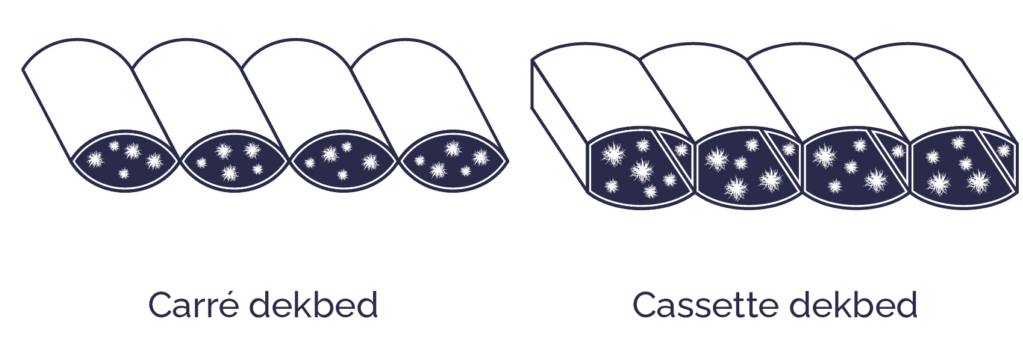
The cassette duvet
A cassette duvet is divided into sections by means of open standing partitions. These partitions ensure that all the down is, as it were, connected to each other. This connection makes the duvet warm and prevents small cold spots from forming. A cassette-stitched duvet therefore provides excellent insulation.
The carré duvet
A carré duvet is divided into blocks by stitching the top and bottom of the ticking directly together. However, these blocks provide less insulation compared to a cassette duvet. As can be seen in the illustration, there are gaps between the blocks because the top and bottom layers are fully stitched together at those points. This means that some parts of the down are not connected, and as a result, cold spots can occur.
Which is the best choice?
Duvets in the mid-range or lower price segments are usually carré stitched. Higher-quality duvets in the upper price ranges are generally cassette stitched. Cassette duvets insulate better and have no cold spots, making them much more comfortable.